View All Posts Christmas December

How to Microwave Chestnuts

Ross Young
Updated:
How to Microwave Chestnuts featured image

Key Takeaways

  • Cutting a deep X into the shell before microwaving is non-negotiable — skip it and the chestnuts can burst.
  • Microwave whole chestnuts on high in 1-minute bursts, shaking the plate between each, roughly 4 to 6 minutes for a dozen.
  • Pre-peeled or vacuum-packed chestnuts need far less time — usually 60 to 90 seconds in short bursts.
  • Soaking whole chestnuts for 15 to 20 minutes before cooking softens the shell and makes peeling much easier.
  • Microwaved chestnuts taste great but won't have the smoky char you get from oven or open-flame roasting.

Can You Microwave Chestnuts?

Every December I end up with a paper bag of chestnuts and a to-do list a mile long, so the oven isn’t always an option.

The microwave has bailed me out more times than I can count, and it works better than most people expect.

The short answer is yes — you can microwave chestnuts safely, and it takes under 10 minutes start to finish.

The whole trick comes down to one step: cutting the shell properly before the chestnuts ever go near the microwave.

Chestnuts are also unusual among tree nuts, since they’re mostly starch rather than fat, which is part of why they cook up soft rather than crunchy (USDA FoodData Central: Nuts, Chestnuts, European, Raw).

If you’re already leaning on the microwave for quick weeknight sides, the same logic applies to something like how to microwave baby potatoes — fast, hands-off, and no oven preheat required.

Roasted chestnuts with dark shells on a blue-gray cooking surface`

What You Need Before You Start

You don’t need anything fancy for this — a knife, a plate, and a microwave will do it.

I always use a small paring knife because it gives me more control than a chef’s knife when I’m cutting into a curved shell.

A microwave-safe plate works fine; skip anything metallic or with metallic trim.

Keep a kitchen towel nearby too — you’ll want it for handling the plate and for peeling once the chestnuts are hot.

If you plan to serve these alongside other quick microwave sides, dishes like how to microwave frozen peas round out a plate without adding much extra work.

How to Microwave Chestnuts Step by Step

Here’s the exact process I use every time, no guesswork involved.

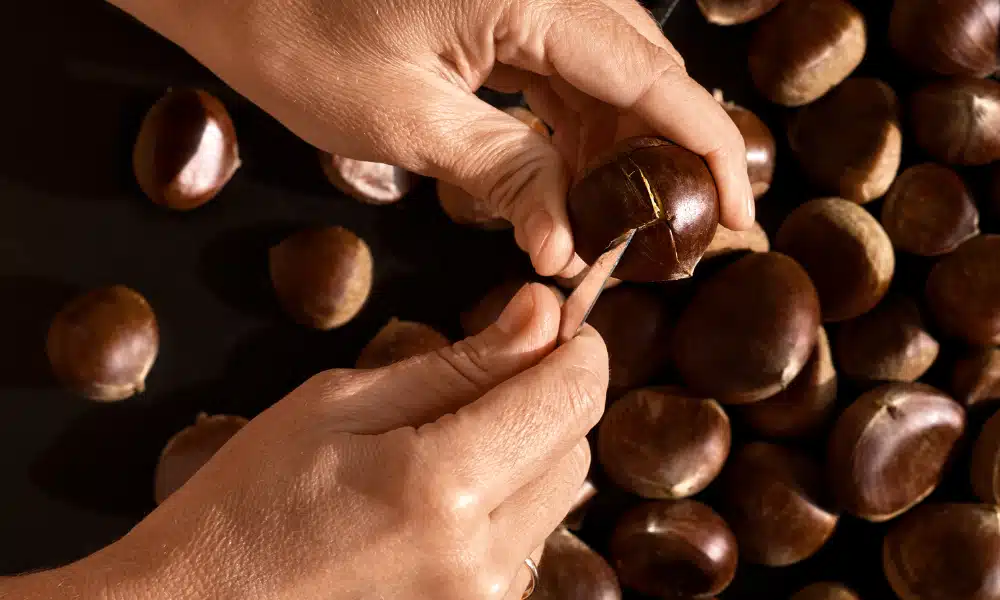
  1. Score each shell. Lay the chestnut flat-side down and cut a firm X or cross about 1/4 inch deep into the rounded top, through the shell and into the flesh.
  2. Arrange in a single layer. Spread up to a dozen chestnuts, cut-side up, on a microwave-safe plate. Don’t stack or crowd them.
  3. Microwave on high for 1 minute. Pull the plate out and give the chestnuts a shake.
  4. Repeat in 1-minute bursts. Keep microwaving and shaking every minute until the shells curl back at the cut and the flesh feels tender when pressed.
  5. Rest for 2 minutes. This lets the heat finish working through without overcooking the outside edge.
  6. Peel while warm. Chestnuts peel far easier hot than cold, so tackle them right away with a towel protecting your fingers.

University extension research on chestnuts backs this up — scoring or piercing the shell before high-heat cooking is the standard recommendation to keep them from bursting (University of Missouri Center for Agroforestry: Chestnut FAQ).

One thing that trips people up: microwaves vary a lot in wattage, so treat that timing as a starting point, not a rule.

Two halved chestnuts showing opened shells and inner kernels on ground
How to Microwave Chestnuts infographic

How Long to Microwave Chestnuts (Timing Guide)

Timing depends on how many chestnuts you’re cooking and how powerful your microwave is.

I run a 1000-watt microwave, and a dozen chestnuts usually take about 5 minutes total.

Lower-wattage microwaves, closer to 700 or 800 watts, can need 7 or 8 minutes for the same batch.

The table below is what I use as a baseline, then I adjust based on how the shells look.

Whatever the wattage, judge doneness by the shell, not the clock — it should peel back at the cut and look slightly blistered.

Rough microwave timing for whole chestnuts, adjusted for wattage
Amount 1000W Microwave 700-800W Microwave
6 chestnuts 3 to 4 minutes 5 to 6 minutes
12 chestnuts 4 to 6 minutes 6 to 8 minutes
20 chestnuts 7 to 9 minutes 9 to 11 minutes

Can You Roast Chestnuts in a Microwave?

Technically, no — roasting means dry heat browns and caramelizes the outside, and a microwave cooks with moist heat instead.

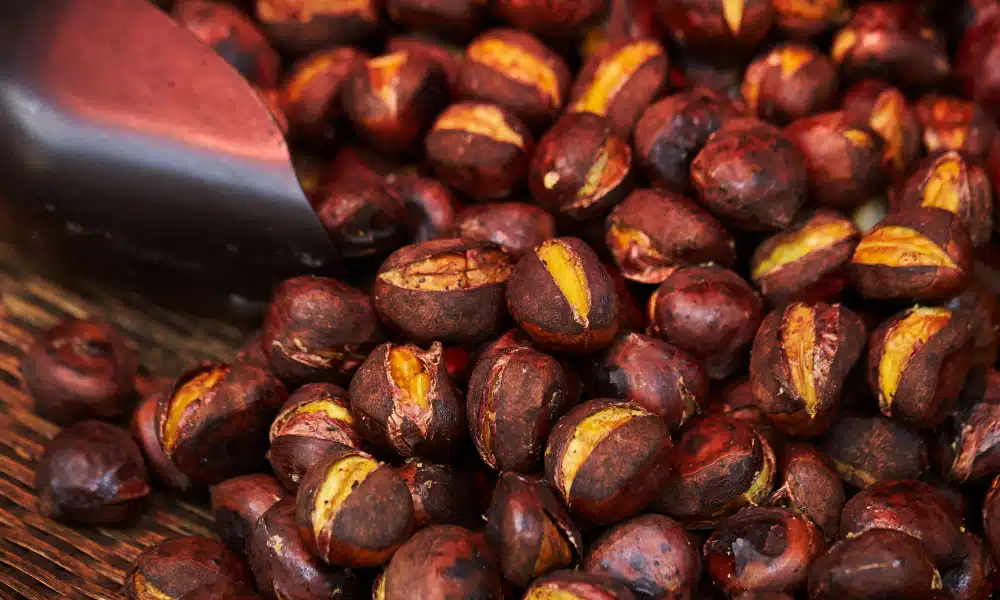
What a microwave gives you is the same tender, cooked interior as roasted chestnuts, just without the charred shell or smoky edge.

If you want that roasted look and flavor, finish microwaved chestnuts under the broiler for 2 to 3 minutes after peeling, watching closely so they don’t burn.

I do this every year when I want the aroma of roasted chestnuts without babysitting a stovetop pan for 20 minutes.

It’s a similar idea to how a dish like how to microwave mushrooms comes out tender rather than browned and caramelized — moist heat and dry heat just behave differently.

Cooking Already-Peeled Chestnuts in the Microwave

If you bought pre-peeled or vacuum-packed chestnuts, the process is much simpler — and much faster.

There’s no shell to score, so skip that step entirely.

Tip the peeled chestnuts onto a microwave-safe dish, add a splash of water, and cover loosely.

Microwave on high in 30-second bursts, stirring between each, until warmed through — usually 60 to 90 seconds total for a cup or two.

Peeled chestnuts scorch and dry out fast, so short bursts beat one long blast.

These warmed-through chestnuts are great stirred into stuffing, soups, or a heartier plate alongside something like how to microwave lentils.

Tips for the Best Microwaved Chestnuts

A few things I’ve learned the hard way over the years.

Soak First for Easier Peeling

Soak whole chestnuts in warm water for 15 to 20 minutes before cutting and cooking.

It softens the shell and the thin skin underneath, so the peel comes away in one piece instead of little stubborn flakes.

Cut Deep Enough, But Not Too Deep

Score through the shell and into the flesh slightly, about 1/4 inch.

Too shallow and steam can’t escape; too deep and you’ll cut into the nut itself, drying it out as it cooks.

Season Them Right After Peeling

Chestnuts take on flavor best while they’re still warm.

A pinch of salt and a little melted butter is my go-to, though cinnamon and sugar makes them taste like a holiday market snack.

If you’re setting up a whole snack spread, something warm and simple like how to microwave baked beans pairs surprisingly well with chestnuts on a cold-weather table.

Microwave vs. Traditional Roasting: Which Is Better?

Both methods get you to tender, cooked chestnuts — they just get there differently.

Why Microwaving Wins on Convenience

It’s faster, it doesn’t heat up your whole kitchen, and you don’t need to stand over a hot pan shaking it every few minutes.

For a quick snack or a last-minute holiday appetizer, I reach for the microwave every time.

Why Oven Roasting Still Has an Edge

Dry heat from an oven or open flame caramelizes the natural sugars in the chestnut and gives the shell that deep, smoky char.

That flavor and crackly texture is genuinely different from a microwaved chestnut, which stays softer and milder.

If I’m cooking for a crowd and have the time, I’ll still roast in the oven at 425°F for about 20 minutes.

But on a weeknight, or when the oven’s already busy with everything else, the microwave is the one I actually use.

Chestnut Safety: Explosions, Undercooking, and Allergies

The exploding-chestnut warning is real, and it’s the single biggest thing to get right.

Steam builds up fast inside a sealed shell, and without an escape route through that cut, it can rupture with real force.

Microwaves are also known for heating unevenly, so shaking or rotating the plate partway through helps chestnuts cook more consistently and lowers the risk of scorched or raw spots (USDA FSIS: Microwave Ovens and Food Safety).

Undercooked chestnuts taste starchy and chalky rather than dangerous, so if they’re not tender yet, just give them another minute.

One important warning to understand: chestnuts aren’t part of the standard list of major food allergens, but tree nut allergies and related reactions do happen, and symptoms can range from mild to serious.

If you or a guest has a known nut allergy, check in before serving chestnuts, and anyone with a suspected allergy should talk to a healthcare professional rather than test it at the table (MedlinePlus: Nut Allergy).

Also skip any chestnuts with soft, discolored, or moldy shells — cooking doesn’t fix spoilage, it just warms it up.

Frequently Asked Questions

Do you need to boil chestnuts before microwaving them?

No. As long as you cut a slit or an X into the shell first, you can microwave chestnuts straight from raw without boiling or soaking them.

How do you know when microwaved chestnuts are done?

The shell curls back at the cut and looks slightly blistered, and the flesh underneath feels tender when you press it, not hard or starchy.

Can you microwave chestnuts without cutting them first?

You shouldn't. Steam builds up inside the sealed shell as it cooks, and without a cut to let it escape, the chestnut can burst inside the microwave.

How many chestnuts can you microwave at once?

Stick to a single, uncrowded layer on the plate — around 12 to 20 chestnuts depending on plate size — so they heat evenly and none get missed when you shake them.

Can you microwave chestnuts that are already peeled or vacuum-packed?

Yes, and it's much quicker. Skip the scoring step, add a splash of water, cover loosely, and microwave in 30-second bursts for about 60 to 90 seconds total.

3 thoughts on “How to Microwave Chestnuts”

  1. How come all the chestnuts I buy are moldy?
    They look ok in the store, but when I put the slit in the shell they might look ok but after I bake them they are moldy.
    How can I make sure they are not moldy?

    Reply
    • Hi there,
      I’m in Australia and have only recently tried chestnuts. I noticed that they can be furry/fuzzy between the harder outer shell and the thinner casing around the kernel. Perhaps this is what you might think is mould.

      Reply

Leave a Comment