

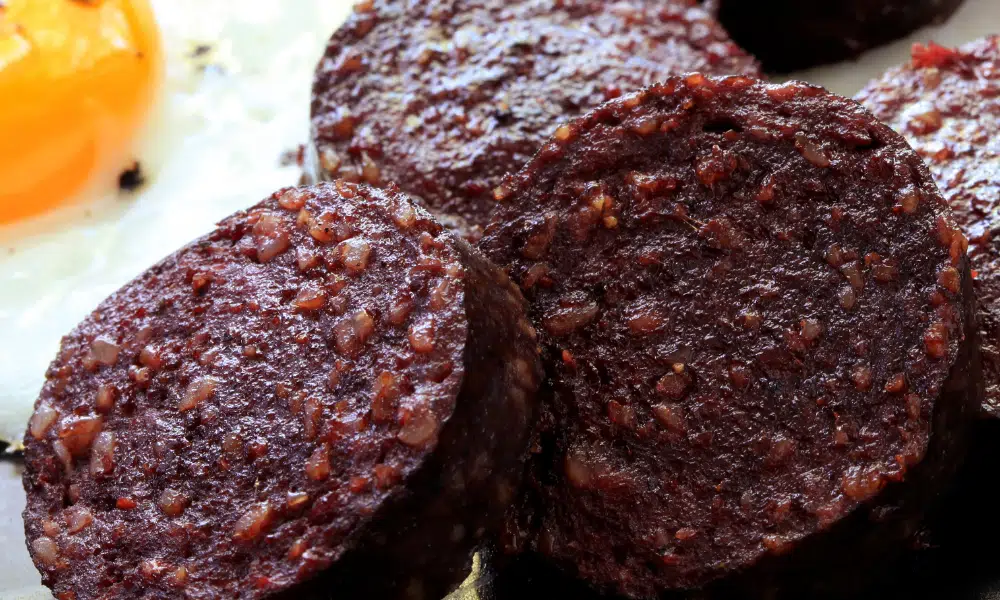
We won’t tell you what black pudding consists of. You either know already, don’t care, or don’t want to know! In spite of its composition, black pudding is a popular breakfast option and is a feature on many English (and Scottish) cooked breakfasts.
Although it’s most commonly cooked in a frying pan, on the grill, or in the oven, here’s how to microwave black pudding instead.
To microwave black pudding, place it on a microwave-safe plate and microwave for between 30 and 60 seconds until it is warmed through.
How to Microwave Black Pudding
It’s fair to describe black pudding as divisive! Some love it; others hate it.
But as a popular breakfast option, you’ll be pleased to hear you can microwave it in a matter of minutes, saving you the time and hassle of preparing it on the stovetop or in the oven.
Here’s how to go about it:
- Remove Wrapping & Slice (If Necessary)
If you have a block of black pudding, you will need to cut it into slices before you microwave it. You should also remove any wrap or seal that has been used to hold your black pudding together. - Place on a Microwave-Safe Plate
Put your slices of black pudding on a microwave-safe plate, so they’re side-by-side and not touching. - Heat
On your microwave’s highest setting, cook your black pudding for sixty seconds. You can then check it for doneness and then cook it for a further 30-60 seconds if necessary. - Check Temperature
You will need to check that your black pudding is up to 75C or 165F before eating it. - Serve and Enjoy
Add your black pudding to your cooked breakfast and enjoy! With enough brown sauce, you won’t even know it was cooked in the microwave.
How to Microwave Black Pudding Successfully
Although microwaving black pudding is pretty easy, here are three tips to keep you on the straight and narrow:
- Finish It In the Frying Pan – If you’re rustling up a delicious cooked breakfast for yourself and have the frying pan out, consider throwing your black pudding into the oil for 20 seconds on each side after you’ve taken it out of the microwave. This will make it nice and crispy and will improve its texture.
- Defrost Before Microwaving – You might decide to freeze your black pudding to preserve it for that little bit longer. While this is fine, you should defrost it before you cook it in the microwave.
- Consider Other Ways of Cooking It – Of all the ways to cook black pudding, microwaving produces the most disappointing results. It’s much better fried, grilled, or even oven-baked. If you’re not in a rush, consider cooking your black pudding differently.
Why You Should Microwave Black Pudding
Although microwaving black pudding isn’t the best idea, there are a couple of benefits in doing so:
Quick
Cooking black pudding should take no more than 90 seconds on full power. Therefore, if you’ve forgotten to cook it at the same time as your other breakfast ingredients, you can fire it in the microwave and cook it quickly.
Not Too Messy
If you’re cooking black pudding on its own, you probably don’t want to dirty your grill or pan just for the sake of it. Cooking black pudding in the microwave saves you some time when it comes to the dishes much like other breakfast staples.
This tends to be one of the reasons to microwave any food ingredients – it saves on a lot of the clearing up.
Why You Shouldn’t Microwave Black Pudding
However, it’s really not all good news and if you’re a fan of black pudding then it might be worth steering clear of the microwave:
Disappointing Texture
Most people love black pudding that is crispy on the outside and soft on the inside. Microwaved black pudding tends to be soft all over and isn’t overly exciting!
This is why most people choose to cook it in a frying pan or under a grill. The resulting black pudding is crispy on the outside by still soft in the centre.
Easy to Overcook
If you leave your black pudding in the microwave for too long, it will spoil and dry out. It should take no more than ninety seconds, but you should check it after a minute to check its doneness.
In a pan, a few seconds too long is unlikely to cause major textural issues or overcooking. A few seconds too long in the microwave can take your black pudding from perfect to dry almost instantly.
Microwaving Black Pudding FAQs
We’ve covered the basics on how to go about microwaving black pudding above, but if you still have questions then the below may help you out:
Yes, like black pudding, white pudding can be microwaved but the same issues will occur with the texture. The best way to cook white pudding is in a frying pan or under the grill.
If you want black pudding with a crispy exterior and soft inside then the best way to cook it is in a hot pan with a drop of oil. Of course, this isn’t the healthiest but it sure is the tastiest way to cook it. Bury Black Pudding have a full guide on cooking it here.
Generally, black pudding is cooked when you buy it. It is usually simmered in a pot of water. However, it won’t have the most pleasant texture when not cooked so it’s still worth cooking it at home once you’ve sliced it.
Yes, you can reheat black pudding in the microwave, but you need to be really careful not to dry it out. Begin by placing your black pudding on a microwave-safe plate and cover it with film. Reheat your black pudding for thirty seconds at a time, checking its doneness each time. When piping hot, it will be ready to serve.

Lewis is the founder and editor of Let’s Foodie alongside other food-related platforms including FreezeIt and SubstituteIt. He launched Let’s Foodie to provide aspiring cooks with one place to get the answers to some of the most commonly asked cooking questions.