

Mushy rice is one of the most common letdowns in the kitchen, and it almost never means you’re bad at cooking rice.
Mushy rice almost always comes down to too much water, too much heat, or too much time in the pot — sometimes all three at once.
The good news is that once you know which one is the culprit, it’s an easy fix. It’s also an easy thing to prevent next time.
Key Takeaways
- Most mushy rice comes from using too much water for the type and amount of rice you cooked.
- Lifting the lid or stirring while rice cooks releases steam and starch, making it gummy.
- You can often rescue mushy rice by drying it out gently on the stove or in the oven.
- Rice types need different water ratios — jasmine and basmati need less water than short-grain rice.
- Leftover rice turns to paste fast when reheated with too much added water.
Fix It Fast: What's Going Wrong
Match what you're seeing to the fastest fix.
| What Went Wrong | Best Fix |
|---|---|
| Rice looks wet and gluey right after cooking | Spread it on a baking sheet and dry it in a 300°F oven for 5-10 minutes |
| Rice was fine, then went mushy sitting covered | Take the lid off, fluff with a fork, and let steam escape for a few minutes |
| Rice cooker rice always comes out soft | Recheck your cup measurements — rice cooker cups are smaller than a standard US cup |
| Fried rice turns soft and clumpy in the pan | Use cold, day-old rice and cook it in a very hot, uncrowded pan |
| Reheated leftover rice turns to paste | Reheat with only a tablespoon or two of water, covered, over low heat |
Why Is My Rice Mushy?
Mushy rice means moisture stayed in the pot longer than the rice could handle before it turned soft and clumped together.
It usually comes down to one or more of these:
- Too much water for the amount of rice you cooked
- Cooking on too high a heat after the water boils, so it steams unevenly instead of absorbing evenly
- Lifting the lid to check on it, which lets steam escape and throws off the timing
- Stirring the rice while it cooks, which releases surface starch and makes it gluey
- Using older, broken, or lower-quality rice grains that release more starch as they cook
- Leaving the rice on the heat, or in the cooker, past the point it’s actually done
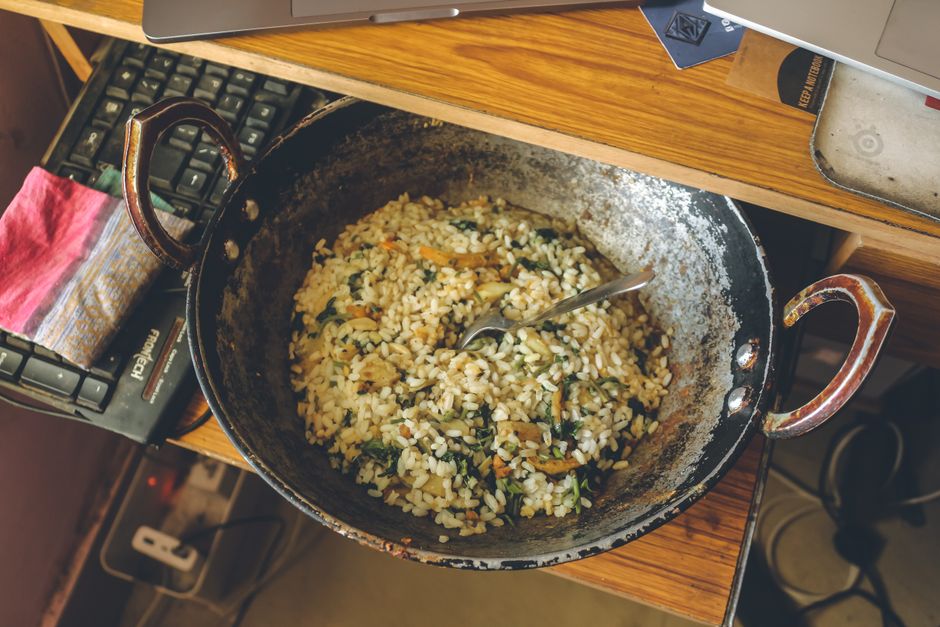
If your rice is soupy with visible standing water, that’s an excess-water problem. If it’s dry on top but sticky and clumped, that’s usually overcooking or too much stirring.
What's the Right Water-to-Rice Ratio for Rice?
There’s no single ratio that works for every rice, and using one all-purpose ratio is the number one reason rice turns out mushy.
Long-grain white rice, jasmine, basmati, short-grain, and brown rice all absorb water at different rates because of how much starch and bran they contain.
Baked rice dishes work on the same principle. A chicken and rice tray bake recipe or a coconut rice and chicken tray bake recipe only turns out right when the broth-to-rice ratio matches the rice you’re using — too much liquid for the pan leaves it swimming instead of fluffy.
Use the table below as a starting point, then adjust slightly based on your pot and stove.
| Rice Type | Water Ratio (water:rice) | Approx. Cook Time |
|---|---|---|
| Long-grain white rice | 1.5:1 | 15-18 minutes |
| Jasmine rice | 1.25:1 | 12-15 minutes |
| Basmati rice | 1.5:1 | 15-18 minutes |
| Short-grain / sushi rice | 1.1:1 | 18-20 minutes |
| Brown rice | 2:1 | 40-45 minutes |
| Arborio (risotto) rice | added gradually | 18-20 minutes, stirred |
How to Fix Mushy Rice After It's Cooked
Mushy rice is usually salvageable if you catch it early. The goal is to get rid of the extra moisture without cooking the rice any further.
- Take the lid off completely and let steam escape for 2-3 minutes.
- Spread the rice in a thin, even layer on a baking sheet.
- Dry it in a 300°F (150°C) oven for 5-10 minutes, checking often.
- Or fluff it in a wide, uncovered skillet over low heat, stirring gently.
- Fluff with a fork every couple of minutes so moisture evaporates evenly instead of pooling.
If it’s too far gone to serve as a side, don’t toss it. Mushy rice still works fine folded into soup as a thickener, pressed into rice cakes, or blitzed into a batch of fried rice once it’s cooled and dried out a bit.

Why Rinsing Rice Matters
Skipping the rinse is a quiet cause of mushy, gluey rice, especially with white and jasmine varieties.
Milled rice is coated in loose surface starch left over from processing. That starch dissolves into the cooking water and makes the grains clump together as they cook.
Rinse rice in a colander or bowl under cool water until the water runs mostly clear, usually 2-3 changes of water. Even short-grain sushi rice, which is sticky by design, still needs a rinse to control how sticky it ends up.
Why Is My Rice Cooker Rice Mushy?
Rice cookers usually turn out mushy rice for one simple reason: the water measurement is off, not the machine.
Most rice cookers come with their own measuring cup, which is smaller than a standard US cup, roughly 3/4 cup. Using a regular measuring cup instead throws the ratio off every time.
Other common causes include an older cooker whose sensor no longer switches to keep-warm at the right moment, or lifting the lid mid-cook to check progress. Stick to the markings on the inner pot and the cooker’s own cup, and resist opening it early.
Why Is My Fried Rice Mushy?
Fried rice usually turns soft and clumpy when the rice going into the pan is still warm and moist instead of cold and dried out.
Freshly cooked rice is soft and holds a lot of surface moisture. Once it hits a hot pan, that moisture steams the grains instead of letting them fry and separate.
Overcrowding a pan or wok causes the same problem — the rice steams in its own moisture instead of getting real contact with the hot surface.

Use rice that’s been refrigerated overnight, cook in small batches over high heat, and go light on sauce. Recipes like chicken fried rice, Chinese fried rice, and kimchi fried rice all rely on this cold, dry-rice trick to get separate, slightly chewy grains instead of a soft, clumped mass.
How to Store Leftover Rice Without It Going Mushy
Leftover rice turns mushy fast when it’s reheated with too much liquid, or when it wasn’t cooled and stored properly to begin with.
Cool rice within about an hour of cooking rather than leaving it out at room temperature, since cooked rice can contain Bacillus cereus spores that multiply as it sits warm. The CDC’s guidance on food safety basics covers why quick cooling and proper storage matter for rice specifically.
Store it in an airtight container in the fridge, and check the FoodKeeper App for how long it stays good, since guidance is more specific than a flat ‘a few days’ rule.
The USDA’s guidance on leftovers and food safety is a useful reference for reheating temperatures too. When you reheat, add only a tablespoon or two of water, cover, and warm it gently — a full splash of water is what turns leftover rice into paste.
Fluffy Rice vs. Rice That's Meant to Be Soft
Not every soft rice dish is a mistake. Some dishes are built to be creamy or soft on purpose, using techniques that would ruin a plain side of rice.
Risotto and congee are stirred constantly and cooked with extra liquid added gradually, which releases starch on purpose to build a creamy texture.
Rice pudding works the same way. A creamy rice pudding recipe or a baked rice pudding recipe uses extra milk and long, low cooking to get soft, almost dissolved grains — that’s success, not a mistake.
If you’re aiming for a plain fluffy side and it comes out like this instead, that’s the mushy-rice problem covered above. If you’re making a pudding or risotto, soft is exactly the goal.
The Bottom Line
Mushy rice almost always means too much water, too much heat, or too much time — check your ratio first, then your habit of lifting the lid or stirring.
If it’s already mushy, dry it out on a low oven tray or in an uncovered skillet before writing off the batch. Match your water ratio to the actual rice you’re cooking next time, and mushy rice mostly stops being a problem.
Frequently Asked Questions
Why is my rice mushy even though I followed the recipe?
Recipes assume a specific rice type, pot, and stove heat. If your rice, pot size, or burner runs differently, the same measurements can leave too much water in the pot, resulting in mushy rice.
Can you fix rice after it's already mushy?
Often yes. Spread it on a baking sheet and dry it in a 300°F oven for 5-10 minutes, or fluff it uncovered over low heat on the stove until the extra moisture evaporates.
Why does jasmine rice get mushy so easily?
Jasmine rice is softer and lower in the starch that holds grains firm, so it needs less water and a shorter cook time than long-grain white rice. Using the same ratio for both usually makes jasmine rice mushy.
Is mushy rice safe to eat?
Texture alone doesn’t make rice unsafe. The real safety concern is rice that sat out at room temperature too long, since cooked rice can harbor Bacillus cereus spores that multiply as it cools slowly.
Why is my brown rice always mushy?
Brown rice needs close to double the water of white rice and a longer cook time because the bran layer slows water absorption. Using a white-rice ratio or timing on brown rice almost always turns it mushy.